

Top Benefits of AI-Powered Predictive Maintenance in Industry
- Apr 23
- 22 min read
Industries are rapidly moving from scheduled servicing models to fully autonomous, AI-driven maintenance ecosystems. Nowhere is this shift more critical—or more advanced—than in aviation, where downtime costs, safety constraints, and operational complexity make predictive intelligence a strategic necessity rather than an optimization layer.
This guide breaks down the full evolution, architecture, technologies, business impact, and real-world implementation of AI predictive maintenance systems designed for aviation-grade environments and beyond.
Modern aviation ecosystems are increasingly supported by specialized technology providers such as an aviation software development company that builds advanced platforms for predictive maintenance, fleet monitoring, and operational intelligence. These systems are often developed in collaboration with airline software development services teams to ensure seamless integration with existing airline operations and regulatory compliance frameworks.
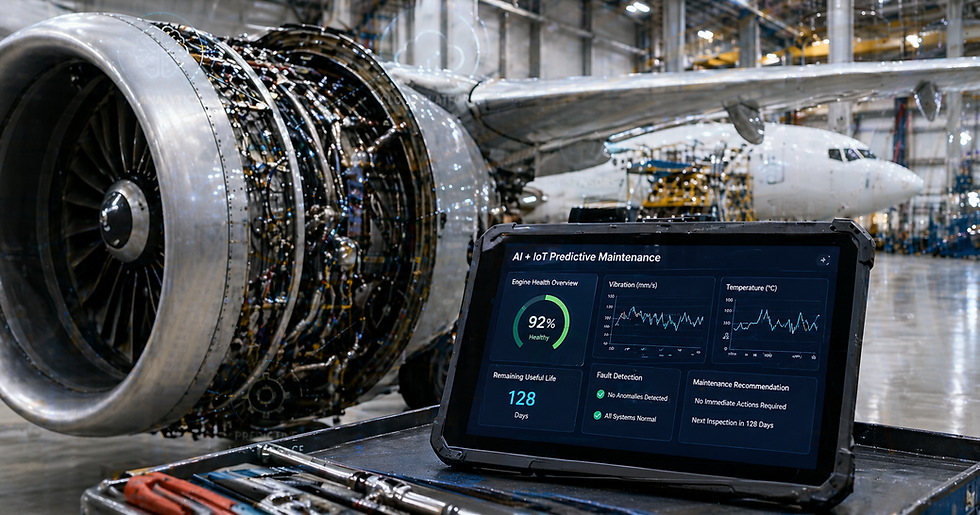
AI predictive maintenance in aviation is an advanced data-driven approach that uses machine learning, IoT sensors, and real-time analytics to predict equipment failures before they occur. It improves aircraft safety, reduces downtime, and optimizes maintenance scheduling across fleets. Modern systems leverage LLMs, anomaly detection models, deep learning, and digital twins to analyze engine performance, structural health, and flight telemetry. Integrated with cloud and edge computing, these AI models enable scalable and real-time decision-making. Aviation software development services support deployment of such intelligent systems, making maintenance more autonomous, efficient, and aligned with next-generation AI-driven industrial operations across global aviation networks.
Evolution of Industrial Maintenance: From Reactive to Autonomous Systems
Industrial maintenance has evolved in clear stages, moving from simple repair-after-failure approaches to intelligent systems that can predict, optimize, and eventually automate maintenance decisions. Each stage improves reliability, reduces downtime, and increases operational efficiency.
1. Reactive Maintenance (Break-Fix Model)
This is the most basic approach where equipment is repaired only after it fails. There is no prediction or planning involved.
It leads to high downtime, unexpected breakdowns, and operational disruption. Since failures are not anticipated, costs are often higher due to emergency repairs. This model is now considered outdated, especially in critical industries like aviation.
2. Preventive Maintenance (Scheduled Maintenance)
In this approach, maintenance is done at fixed time intervals or after a set number of usage hours, regardless of equipment condition.
It reduces sudden failures but is inefficient because machines may be serviced even when they are still working properly. This leads to unnecessary cost and resource usage.
3. Condition-Based Maintenance
Here, maintenance is based on real-time equipment condition using sensors. Parameters like temperature, vibration, and pressure are continuously monitored.
When readings cross a defined threshold, maintenance is triggered. This improves efficiency but still reacts after signs of degradation appear.
4. Predictive Maintenance (AI-Based Forecasting)
This stage uses machine learning and historical data to predict failures before they occur.
Instead of waiting for damage or thresholds, the system analyzes patterns and estimates when a component might fail. This helps reduce downtime and optimize maintenance planning.
5. Prescriptive Maintenance
Prescriptive maintenance not only predicts failures but also suggests the best action to take.
It uses AI-driven decision systems to recommend the most cost-effective and efficient maintenance strategy based on multiple operational factors.
6. Autonomous Maintenance Systems (2026+)
This is the most advanced stage where systems can monitor, analyze, and even repair themselves with minimal human involvement.
Powered by agentic AI, these systems can make independent decisions, automate maintenance workflows, and optimize operations continuously. Aviation and defense industries are actively moving toward this future model.
Why Industries Are Rapidly Shifting to AI and IoT
Industries are increasingly adopting AI and IoT-based systems because traditional maintenance and monitoring approaches are no longer sufficient for modern operational demands. The shift is driven by the need for higher efficiency, better safety, and real-time decision-making across complex industrial environments.
1. Real-Time Operational Visibility
Modern IoT sensors continuously collect and transmit data from machines, equipment, and systems. This creates real-time visibility into operational health, allowing companies to monitor performance instantly instead of relying on periodic checks or manual inspections.
2. Cost Pressure in Asset-Heavy Industries
Industries such as aviation, energy, logistics, and manufacturing operate expensive, large-scale assets. Any unexpected downtime can result in significant financial losses. AI and IoT help reduce these losses by improving maintenance planning and minimizing unplanned breakdowns.
3. Safety-Critical Requirements
In sectors like aviation and defense, failure is not an option. Even minor technical issues can lead to serious safety risks. AI-driven monitoring systems help detect early warning signs and ensure systems operate within safe limits, reducing the chances of critical failures.
4. Explosion of Industrial Data
With the growth of IoT devices and edge computing, industries now generate massive amounts of real-time data. Traditional systems cannot process or interpret this volume effectively. AI systems are essential to analyze this data and extract meaningful insights for decision-making.
5. Digital Transformation Pressure
Most industries are undergoing digital transformation, replacing legacy systems with intelligent, data-driven platforms. AI and IoT play a central role in this shift by enabling automation, predictive insights, and smarter operational workflows across the entire industrial ecosystem.
Why Aviation Leads Predictive Maintenance Adoption
Aviation is widely considered the most advanced industry in adopting predictive maintenance because its operational, financial, and safety requirements are far more stringent than most other sectors. This makes it an ideal environment for AI-driven maintenance systems.
To support large-scale digital transformation, airlines often work with airport software developers and enterprise aviation technology providers who design scalable systems for real-time aircraft monitoring, maintenance scheduling, and operational optimization. These solutions are essential for managing complex airline environments where safety, efficiency, and uptime are critical priorities.
Extreme Downtime Cost
In aviation, aircraft downtime directly translates into significant financial loss. When a plane is grounded due to maintenance issues, airlines can lose tens of thousands of dollars per hour. This includes not only repair costs but also lost revenue from canceled or delayed flights. As a result, airlines are highly motivated to predict and prevent failures before they occur.
Regulatory Complexity
The aviation industry operates under strict regulatory frameworks governed by authorities such as the FAA and EASA. These organizations require high levels of reliability, documentation, and traceability for all maintenance activities. Predictive maintenance systems help meet these requirements by providing structured data, audit trails, and explainable decision-making processes.
High Sensor Density
Modern aircraft are equipped with thousands of sensors that continuously monitor engine performance, structural health, temperature, pressure, vibration, and other critical parameters. This rich telemetry data provides an ideal foundation for AI models to detect patterns, anomalies, and early signs of potential failures with high accuracy.
Global Fleet Complexity
Airlines manage large fleets operating across different countries, climates, and usage conditions. This global distribution makes maintenance coordination complex. Predictive maintenance enables centralized monitoring and optimized scheduling across the entire fleet, improving efficiency and reducing logistical challenges.
Zero-Failure Safety Requirement
Aviation is a safety-critical industry where even minor failures can have severe consequences. There is no acceptable margin for error during flight operations. Predictive maintenance helps minimize risk by identifying potential issues early and ensuring aircraft are serviced before failures can occur, supporting the industry’s strict safety standards.
The rise of intelligent aviation platforms has led to increased demand for specialized aviation software development services that integrate predictive maintenance models with enterprise systems such as MRO, ERP, and fleet management tools. These services enable airlines to transition from traditional maintenance workflows to fully data-driven operational ecosystems.
Business Impact of AI Predictive Maintenance
AI-driven predictive maintenance delivers measurable improvements in both operational efficiency and financial performance. By shifting from reactive or scheduled servicing to data-driven forecasting, organizations can significantly optimize how assets are maintained and utilized.
Reduced Downtime (30–50%)
One of the most important benefits is a major reduction in unplanned downtime. Since failures are predicted in advance, maintenance can be scheduled proactively. This prevents sudden breakdowns and ensures equipment or aircraft remain operational for longer periods.
Lower Maintenance Costs (20–40%)
Predictive systems help avoid unnecessary servicing and emergency repairs. Maintenance is performed only when required, based on actual condition and predicted risk. This reduces labor costs, spare part usage, and expensive last-minute repair operations.
Improved Fleet or Asset Utilization
With fewer unexpected interruptions, assets such as aircraft, industrial machines, or vehicles spend more time in active service. This improves overall utilization rates and increases revenue-generating capacity without requiring additional resources.
Stronger Regulatory Compliance
Predictive maintenance systems generate structured, traceable, and data-backed maintenance records. This helps organizations meet strict regulatory requirements more efficiently, especially in industries like aviation, energy, and defense where compliance is critical.
Reduced Emergency Repairs
By identifying potential failures early, organizations can significantly reduce emergency maintenance situations. This leads to better planning, lower operational stress, and more controlled maintenance workflows.
Overall Impact on Profitability
Collectively, these improvements create a direct link between AI adoption and business profitability. Reduced downtime, optimized costs, and improved asset efficiency translate into higher operational output and stronger financial performance across the organization.
What is AI Predictive Maintenance?
AI predictive maintenance is an advanced maintenance approach that uses machine learning, IoT sensor data, and statistical modeling to predict equipment failures before they actually occur. Instead of reacting to breakdowns or relying on fixed schedules, systems continuously analyze data to identify early warning signs of potential issues.
This approach shifts maintenance from reactive problem-solving to proactive intelligence, where decisions are made based on data-driven forecasts rather than assumptions or fixed timelines.
Maintenance Paradigm Comparison
Maintenance strategies have evolved progressively from simple scheduling methods to highly intelligent, data-driven decision systems. Each stage increases accuracy, reduces uncertainty, and improves operational efficiency by using more advanced forms of information processing.
Preventive Maintenance
Preventive maintenance is the most basic structured approach. In this model, machines are serviced at fixed time intervals or after a certain amount of usage, regardless of their actual condition.
The main idea is to reduce the chance of unexpected failure by performing regular maintenance. However, this method does not consider real-time machine health. As a result, equipment may be serviced even when it is still in good condition, leading to unnecessary maintenance costs and inefficient resource usage.
Condition-Based Maintenance
Condition-based maintenance improves on preventive methods by introducing real-time monitoring. Instead of relying on fixed schedules, it uses sensor data to assess the actual condition of equipment.
Maintenance is triggered only when specific parameters such as temperature, vibration, or pressure cross predefined thresholds. This makes the process more efficient because servicing is based on actual machine behavior rather than estimated timelines. However, it still reacts after signs of degradation have already appeared.
Predictive Maintenance
Predictive maintenance represents a more advanced, intelligence-driven approach. It uses machine learning models and statistical techniques to analyze both historical and real-time data.
The system identifies hidden patterns in equipment behavior and estimates the probability of future failure. This allows maintenance teams to act before a breakdown occurs, reducing downtime and improving operational planning. Unlike previous models, it is not dependent on fixed thresholds but on probabilistic forecasting.
Prescriptive Maintenance
Prescriptive maintenance is the most advanced stage in this comparison. It not only predicts when a failure might occur but also recommends the best possible action to take.
Using AI-driven optimization models, it evaluates different maintenance strategies based on factors such as cost, timing, operational impact, and resource availability. The system then suggests the most efficient course of action, helping organizations make better and faster decisions.
Core Enablers of AI Predictive Maintenance
AI predictive maintenance works because multiple technologies operate together as a unified ecosystem. Each component plays a specific role in collecting data, processing it, analyzing it, and converting it into actionable insights for maintenance decisions.
IoT Sensor Networks
IoT sensor networks form the foundation of predictive maintenance systems. These sensors are embedded in machines and continuously collect real-time operational data. They measure key parameters such as temperature, pressure, vibration, speed, and load.
This constant stream of data provides a live view of machine health, making it possible to detect subtle changes in performance that may indicate early signs of failure.
Real-Time Data Streaming Pipelines
Once data is collected, it must be processed immediately. Real-time data streaming pipelines handle this task by continuously transferring and organizing incoming sensor data.
These systems ensure that no important signal is delayed or lost. They enable fast processing of large volumes of data so that potential issues can be identified as soon as they begin to emerge.
Machine Learning Models
Machine learning models are responsible for analyzing both historical and real-time data. They identify patterns that are too complex for traditional rule-based systems to detect.
By learning from past behavior and ongoing performance data, these models can predict when a component is likely to fail. This enables maintenance teams to take action before breakdowns occur, improving reliability and reducing downtime.
Historical Failure Datasets
Historical failure data is essential for training predictive models. It includes records of past breakdowns, maintenance logs, and system behavior before failures occurred.
Machine learning systems use this data to understand how failures develop over time. This learning process helps improve prediction accuracy and ensures that models can recognize similar patterns in future operations.
Cloud and Edge Computing Infrastructure
Cloud and edge computing provide the processing backbone for predictive maintenance systems. Cloud platforms handle large-scale data storage, model training, and deep analytics.
Edge computing, on the other hand, processes data closer to the source, enabling faster decision-making with minimal delay. Together, they ensure that predictive maintenance systems are both scalable and capable of delivering real-time insights.
Industrial-Grade System Architecture
In predictive maintenance systems, especially in aviation and other high-value industries, the architecture is designed in layers. The first and most important layer is the Data Acquisition Layer. This layer is responsible for collecting all raw information from the physical aircraft or machine. Without accurate and continuous data from this layer, no AI model can make reliable predictions.
Think of this layer as the “sensing system” of the entire predictive maintenance setup. It captures what is happening inside the machine in real time and sends it forward for analysis.
Engine Sensors
Engine sensors are placed inside and around the aircraft engine to continuously monitor its performance. These sensors track critical parameters such as temperature, fuel flow, pressure, vibration, and rotational speed.
The reason this data is important is that engine failure usually does not happen suddenly. It develops gradually through small performance changes. Engine sensors help capture these small changes early, allowing the system to detect abnormal behavior before it becomes a serious failure.
Structural Health Monitoring (SHM)
Structural Health Monitoring systems are used to observe the physical condition of the aircraft body. This includes parts like wings, fuselage, landing gear, and other structural components.
These systems use advanced sensors to detect stress, fatigue, cracks, and microscopic damage that may not be visible during regular inspections. Over time, repeated stress from flights can weaken structures, and SHM systems help identify these issues early so they can be repaired before they become dangerous.
Flight Telemetry Systems
Flight telemetry systems collect real-time data during flight operations. This includes information such as altitude, airspeed, direction, engine performance, and system status.
This data is important because it shows how the aircraft behaves under real operating conditions. Different environments like high altitude, turbulence, or long-haul flights can affect performance, and telemetry data helps capture these variations in detail.
Maintenance Logs
Maintenance logs are digital records of all past maintenance activities performed on the aircraft. This includes repairs, inspections, part replacements, and reported issues.
This historical data is extremely valuable because it helps AI systems understand how and when failures occurred in the past. By combining this with real-time sensor data, predictive models can identify patterns that indicate future failures.

2. Data Engineering Layer (Critical Foundation)
The Data Engineering Layer is one of the most important parts of a predictive maintenance system because it converts raw sensor data into clean, structured, and meaningful information that AI models can actually use. In simple terms, this layer acts as the “data processing engine” between raw machine signals and intelligent predictions.
Raw data coming from aircraft or industrial machines is often messy, incomplete, and extremely high in volume. Without proper engineering, this data cannot be used effectively for machine learning or analytics.
Stream Processing (Kafka-style Pipelines)
In predictive maintenance systems, data is generated continuously and in real time. Stream processing systems handle this flow of incoming data without delay.
Instead of storing data first and analyzing it later, stream pipelines process it instantly as it arrives. This ensures that important signals, such as sudden changes in engine vibration or temperature spikes, are detected immediately.
In aviation systems, this real-time processing is critical because even a few seconds of delay can affect safety and operational decisions.
Time-Series Normalization
Sensor data is usually collected over time in different formats, scales, and frequencies. Time-series normalization standardizes this data so that it can be properly compared and analyzed.
For example, temperature readings, pressure values, and vibration signals all have different ranges. Normalization converts them into a consistent format, allowing AI models to detect patterns accurately across multiple data types.
Without this step, models may misinterpret differences in scale as meaningful patterns, leading to incorrect predictions.
Missing Data Handling
In real-world systems, sensor data is often incomplete due to hardware issues, communication delays, or temporary sensor failures. Missing data handling ensures that these gaps do not break the analysis process.
Techniques such as interpolation, data imputation, or statistical estimation are used to fill missing values. This helps maintain data continuity and prevents errors in machine learning models.
This step is especially important in aviation, where even small gaps in data can affect the accuracy of predictive systems.
Feature Engineering
Feature engineering is the process of transforming raw data into meaningful inputs for machine learning models. Instead of using raw sensor values directly, the system extracts patterns, trends, and indicators that better represent machine health.
For example, instead of just using vibration values, the system may calculate vibration trends, frequency changes, or deviation patterns over time.
Good feature engineering significantly improves prediction accuracy because it helps models focus on relevant signals instead of raw noise.
Rare Failure Event Labeling
One of the biggest challenges in predictive maintenance is that equipment failures are rare compared to normal operations. This creates an imbalance in data, making it difficult for models to learn failure patterns.
Rare failure event labeling involves identifying and marking historical failure cases in the dataset. These labeled events are used to train AI models so they can recognize early warning signs of similar failures in the future.
This step is critical because without properly labeled failure data, predictive models cannot learn what “failure behavior” actually looks like.
3. Edge + Cloud Processing Layer
The Edge + Cloud Processing Layer is a hybrid computing system that combines fast local processing (edge) with powerful centralized computing (cloud). This layer is essential in predictive maintenance because it balances real-time responsiveness with deep analytical capability.
In simple terms, it decides what needs to be analyzed immediately on the machine itself and what should be sent to the cloud for deeper intelligence.
Edge AI for Real-Time Anomaly Detection
Edge AI refers to processing data directly near the source, such as inside the aircraft or on onboard computing units. Instead of sending all data to the cloud, critical signals are analyzed locally in real time.
This is important because some issues require instant response. For example, sudden engine vibration spikes or abnormal pressure changes must be detected immediately without waiting for cloud processing.
Edge AI models are usually lightweight and optimized for speed. Their main role is to identify anomalies quickly and trigger alerts when something unusual happens.
Cloud AI for Large-Scale Model Training
While edge systems handle immediate decisions, cloud AI is responsible for heavy computation and long-term learning.
Cloud platforms collect large volumes of data from multiple aircraft or machines over time. This data is used to train advanced machine learning and deep learning models.
Because cloud systems have high computing power, they can run complex algorithms, analyze historical patterns, and continuously improve prediction accuracy. This is where models learn deeper insights about failure behavior across entire fleets or industrial systems.
Hybrid Decision Systems
Hybrid decision systems combine both edge and cloud intelligence to create a balanced and efficient architecture.
In this setup, edge AI handles fast, real-time decisions, while cloud AI provides advanced analysis and long-term predictions. The results from both systems are integrated to make final maintenance decisions.
This hybrid approach ensures low latency for critical alerts while still benefiting from large-scale intelligence and continuous model improvement. It is especially useful in aviation, where both speed and accuracy are equally important for safety and operational efficiency.
4. Intelligence Layer (AI Core)
The Intelligence Layer is the central brain of an AI predictive maintenance system. This is where raw and processed data is converted into actionable intelligence. It uses different types of machine learning and simulation techniques to understand equipment behavior, detect risks, and predict future failures.
In simple terms, this layer answers the question: what is happening, why is it happening, and what will happen next.
Supervised Learning (Failure Classification)
Supervised learning is used when the system already has labeled data from past events. The model is trained using examples of both normal operation and failure cases.
It learns to classify whether a machine is operating normally or showing signs of potential failure. This helps in identifying known types of issues based on historical patterns.
Unsupervised Learning (Anomaly Detection)
Unsupervised learning is used when failure labels are not available or when the system needs to discover unknown patterns.
Instead of learning from labeled failures, the model studies normal behavior and identifies anything that deviates from it. These deviations are treated as anomalies, which may indicate early signs of malfunction or unexpected behavior.
Deep Learning (LSTM and Transformers)
Deep learning models are used to handle complex time-series data generated by sensors.
LSTM networks are effective in understanding sequential patterns, such as how engine performance changes over time. Transformer models, on the other hand, are powerful in capturing long-range dependencies across large datasets.
These models improve prediction accuracy by learning deep and hidden relationships in operational data.
Survival Analysis (Time-to-Failure Prediction)
Survival analysis focuses on estimating how long a component will continue to operate before it fails.
Instead of simply predicting whether a failure will happen, this method estimates the remaining useful life of equipment. This helps maintenance teams plan interventions at the most optimal time.
Digital Twin Simulations
Digital twins are virtual replicas of physical systems, such as aircraft engines or entire aircraft.
These simulations replicate real-world conditions and allow AI models to test different scenarios without affecting actual operations. By combining physics-based models with AI, digital twins help predict how systems will behave under different stress conditions and usage patterns.
5. MLOps Layer (Critical for Scale)
The MLOps Layer ensures that machine learning models used in predictive maintenance remain accurate, reliable, and continuously updated in real-world environments. It focuses on managing the entire lifecycle of AI models after they are deployed.
CI/CD for ML Models
CI/CD (Continuous Integration and Continuous Deployment) automates how machine learning models are built, tested, and deployed. This ensures that new or improved models can be updated quickly without disrupting the system.
Model Drift Detection
Over time, real-world data changes, which can reduce model accuracy. Model drift detection identifies when a model’s performance starts degrading so that corrective action can be taken.
Continuous Retraining Pipelines
These pipelines automatically retrain models using new incoming data. This keeps predictions up to date and improves accuracy as system behavior evolves.
A/B Testing of Models
A/B testing compares different versions of models in real conditions to determine which one performs better. This helps in selecting the most accurate and efficient model for deployment.
Monitoring Dashboards
Monitoring dashboards provide real-time visibility into model performance. They track accuracy, errors, and system health, allowing engineers to quickly identify and fix issues.
6. Action Layer
The Action Layer is the final stage of a predictive maintenance system where AI-generated insights are converted into real operational decisions. It connects intelligence with execution, ensuring that predictions actually lead to maintenance activities.
Automated Maintenance Alerts
When the system detects a potential failure, it automatically sends alerts to engineers or maintenance teams. These alerts are generated in real time so that issues can be addressed before they escalate.
Work Order Generation
Instead of manually creating maintenance tasks, the system automatically generates work orders. These include details such as the affected component, type of issue, and urgency level, helping teams respond faster and more accurately.
Scheduling Optimization
The system optimizes maintenance schedules based on predicted failures, resource availability, and operational priorities. This helps reduce downtime and ensures that maintenance is performed at the most efficient time.
Decision Recommendation Engines
These engines provide clear recommendations on what action should be taken. They analyze multiple factors such as cost, risk, and timing to suggest the best possible maintenance strategy for each situation.

Core Technologies Behind Predictive Maintenance
Predictive maintenance systems are built on a combination of advanced technologies that work together to collect data, analyze it, and generate accurate failure predictions. Each technology plays a specific role in enabling intelligent, real-time decision-making.
Machine Learning
Machine learning forms the foundation of predictive maintenance. It includes classification models to identify failure vs non-failure conditions, regression models to estimate values like remaining useful life, and reinforcement learning to improve decision-making over time through feedback.
Deep Learning
Deep learning is used for complex pattern recognition in large-scale sensor data. LSTM models are effective for time-series forecasting, while Transformer models help capture long-range dependencies in operational data for more accurate predictions.
Digital Twin Systems
Digital twins are virtual replicas of physical assets such as aircraft or engines. They simulate real-world behavior using both physics and AI, allowing systems to test scenarios and predict failures without affecting actual operations.
IoT Sensor Architectures
IoT sensors continuously collect real-time data from machines. These architectures form the data backbone of predictive maintenance by capturing parameters like temperature, vibration, pressure, and performance metrics.
Edge AI Systems
Edge AI processes data directly near the source, such as onboard aircraft systems. It enables fast anomaly detection and immediate response without relying on cloud connectivity.
Cloud Computing Platforms
Cloud platforms handle large-scale data storage, processing, and model training. They support heavy computation and enable predictive models to learn from massive datasets collected across fleets or industrial systems.
Big Data Streaming Engines
Streaming engines process continuous data flows in real time. They ensure that sensor data is analyzed instantly as it is generated, enabling real-time monitoring and fast decision-making.
Explainable AI (XAI)
Explainable AI ensures that predictive models are transparent and understandable. It helps engineers and regulators understand why a model made a specific prediction, which is critical in safety-sensitive industries like aviation.
Predictive Modeling Techniques (Deep AI Layer)
The Deep AI Layer is where raw and processed data is converted into actionable predictions. It uses different modeling techniques depending on whether the goal is to detect failure, identify anomalies, forecast future behavior, or explain decisions.
1. Failure Prediction Models
These models focus on predicting whether a component will fail and when it is likely to happen.
Binary classification models are used to determine whether a system is in a normal state or a failure state.
Time-to-failure regression models estimate how much time is left before a component fails, helping with proactive maintenance planning.
Survival analysis models go further by estimating the probability of a system continuing to operate over time without failure.
2. Anomaly Detection Systems
Anomaly detection identifies unusual patterns in system behavior that may indicate early signs of failure.
Isolation Forest is used to detect outliers by isolating abnormal data points from normal behavior.
Autoencoders are neural networks that learn normal patterns and flag deviations when reconstruction errors are high.
Statistical process control uses traditional statistical methods to monitor variations in system performance and detect abnormalities.
3. Time-Series Forecasting
Time-series forecasting models analyze how system behavior changes over time to predict future states.
LSTM neural networks are effective for sequential data and help capture long-term dependencies in sensor readings.
Temporal Transformer models improve accuracy by analyzing complex relationships across long sequences of data.
Hybrid ARIMA systems combine statistical and machine learning approaches for more stable forecasting in structured time-series data.
4. Explainable AI (XAI)
In aviation and other safety-critical industries, it is not enough for models to be accurate; they must also be understandable.
SHAP value analysis is used to explain how each feature contributes to a prediction.
Feature importance mapping highlights which inputs are most responsible for a model’s decision.
Regulatory compliance transparency ensures that AI decisions can be audited and validated according to strict industry standards.
Aviation Predictive Maintenance Systems
1. Aircraft Health Monitoring Systems (AHMS)
AHMS continuously monitors aircraft condition using real-time data. It tracks engine performance, detects structural fatigue, and analyzes component lifecycle to identify wear and tear early.
2. Real-Time Flight Intelligence
This system analyzes aircraft data during flight to detect anomalies instantly. It uses sensor fusion to combine multiple data sources and generate early predictive alerts for potential issues.
3. Fleet Optimization Systems
These systems use AI to manage entire aircraft fleets more efficiently. They help with aircraft allocation, route optimization, and maintenance-aware scheduling to reduce downtime and improve utilization.
4. MRO Optimization
MRO (Maintenance, Repair, and Overhaul) systems use AI to streamline maintenance operations. They reduce aircraft grounding time, optimize spare parts inventory, and improve overall maintenance scheduling efficiency.
Digital Twin Systems: Aviation Game-Changer
Digital twin systems create a virtual replica of a physical aircraft or its components. This digital model behaves like the real aircraft by continuously receiving live data from sensors and updating itself in real time. It allows engineers and AI systems to study and predict aircraft behavior without physically interacting with the actual machine.
The main value of digital twins is that they connect real-world operations with simulation-based intelligence, enabling safer, faster, and more accurate decision-making in aviation maintenance and operations.
Key Capabilities
Physics-based simulation allows the system to replicate real-world mechanical and environmental behavior of aircraft components under different conditions.
AI-driven behavioral prediction uses machine learning models to forecast how systems will perform in the future based on current and historical data.
Real-time sensor synchronization ensures that the digital model stays updated with live data from the actual aircraft, making it an accurate mirror of real operations.
Failure scenario modeling allows engineers to simulate potential breakdowns and test how the aircraft would respond, helping prevent real-world failures.
Implementation Lifecycle
A predictive maintenance system is built in a structured flow from data collection to full business integration.
First, sensors are installed to collect real-time data from machines. Then data pipelines are created to clean, process, and organize this data for AI use.
After that, machine learning models are trained using both real and simulated failure data to improve accuracy in predicting breakdowns.
Once trained, these models are deployed using a hybrid system where edge computing handles real-time decisions and cloud systems handle heavy processing.
Next, monitoring dashboards are used to track system performance and model accuracy in real time.
The system is then continuously improved through retraining with new data so it stays accurate over time.
Finally, it is integrated with ERP and MRO systems so that predictions directly trigger maintenance planning and business operations.
Industry Case Studies
Airbus
Airbus uses predictive maintenance and real-time aircraft monitoring to detect issues early. This helps reduce unexpected maintenance and improves overall fleet reliability.
Boeing
Boeing applies fleet analytics and predictive scheduling to plan maintenance in advance, improving aircraft availability and reducing downtime.
GE Aviation
GE Aviation uses digital twin models of engines to simulate performance and detect failures early, improving engine life and maintenance accuracy.
Siemens
Siemens uses predictive maintenance in factories and energy systems to monitor machines, predict failures, and reduce operational downtime.
Challenges in AI Predictive Maintenance
AI predictive maintenance is powerful, but it faces several practical challenges.
Technical challenges include noisy sensor data, changing data patterns over time (data drift), and limited computing power on edge devices.
Data challenges occur because actual failure cases are rare, datasets are often unbalanced, and labeling failure data is difficult.
Operational challenges involve integrating with old legacy systems, high infrastructure costs, and scaling solutions across large fleets or assets.
Regulatory challenges are strict in aviation, where systems must be explainable, certified, and safety-validated before deployment.
Cybersecurity challenges arise due to connected IoT systems, risk of data breaches, and the need for strong zero-trust security models.
These issues are addressed using modern solutions like federated learning, cloud-native architectures, AutoML pipelines, and secure edge computing systems.
Future of Predictive Maintenance (2026+)
The future of predictive maintenance is moving beyond prediction toward full autonomy. Systems will not only forecast failures but also make and execute maintenance decisions on their own.
We will see agentic AI systems that can independently manage maintenance tasks, along with self-healing aircraft architectures that can automatically detect and fix minor issues. Maintenance, repair, and overhaul (MRO) processes will become fully automated and highly intelligent.
Edge computing will enable real-time decision-making directly on aircraft or machines, while global fleet intelligence networks will connect and optimize maintenance across entire fleets worldwide.
In this future, maintenance will function as a continuously self-improving system that requires minimal human intervention.
AI-Powered Aviation Software Development by SISGAIN
SISGAIN delivers advanced aviation software development solutions that enable predictive maintenance, real-time aircraft monitoring, and intelligent fleet optimization. As a trusted technology partner, we build scalable airline and airport systems using AI, IoT, and cloud innovation to improve safety, reduce downtime, and accelerate digital transformation for aviation businesses worldwide.
Conclusion: Shift to Autonomous Industrial Intelligence
AI predictive maintenance is evolving from a support tool into a core operational system for aviation and other industries.
The evolution follows a clear path: reactive systems moved to preventive, then predictive, followed by prescriptive, and now toward fully autonomous systems.
Aviation is leading this transformation due to its strict safety standards, high operational costs, and rich data availability, but similar systems will spread across all asset-heavy industries.
Ultimately, maintenance will no longer be scheduled manually. It will be intelligently predicted, automatically optimized, and fully autonomous.
FAQs
What is AI predictive maintenance in aviation?
AI predictive maintenance in aviation is a data-driven approach using IoT sensors, machine learning, and real-time analytics to predict aircraft failures before they occur, improving safety, reducing downtime, and optimizing maintenance scheduling.
What are the main benefits of AI predictive maintenance?
It reduces unplanned downtime, lowers maintenance costs, improves asset utilization, enhances safety, and minimizes emergency repairs. It also enables data-driven scheduling and improves regulatory compliance through accurate, real-time monitoring.
Why is aviation leading predictive maintenance adoption?
Aviation leads predictive maintenance adoption due to high downtime costs, strict safety regulations, and complex global fleet operations. Thousands of onboard sensors generate real-time data, making AI-driven failure prediction highly valuable.
What is the core architecture of predictive maintenance systems?
It consists of IoT sensors for data collection, streaming pipelines for real-time processing, edge and cloud computing for hybrid analytics, machine learning models for prediction, and MLOps systems for deployment, monitoring, and retraining.
What is the future of AI predictive maintenance?
Future predictive maintenance will become autonomous and self-healing using agentic AI. Real-time edge computing, global fleet intelligence, and automated MRO systems will enable near zero-downtime operations with minimal human intervention.


Comments