

How AI & IoT Are Transforming Predictive Maintenance
- Apr 13
- 13 min read

AI and IoT are revolutionizing predictive maintenance in aviation by enabling real-time monitoring of aircraft, ground equipment, and airport infrastructure through sensors that feed data to AI algorithms. These systems predict failures before they occur, reducing unplanned downtime by 15-70%, cutting maintenance costs by 12-30%, and boosting safety and fleet availability. For airport systems developers, this means building or integrating aviation MRO software, aviation fleet management software, and aviation inventory management software with IoT AI capabilities to create proactive, data-driven solutions that optimize operations across airlines and airports.
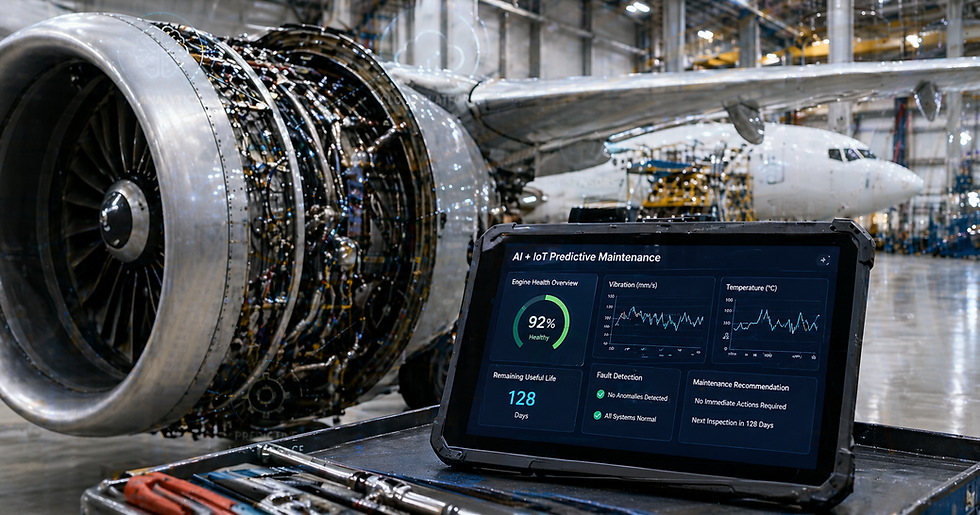
What is AI & IoT predictive maintenance in aviation? It uses IoT sensors for continuous data collection (vibration, temperature, pressure) and AI/machine learning to analyze patterns and forecast failures.
Key benefits: Reduced downtime, lower costs, extended asset life, improved safety.
For airport systems developers: Integrate these into aviation software platforms for MRO, fleet, and inventory management.
Implementation timeline: Pilot in 3-6 months; full scale in 12-18 months with ROI often in under a year.
Airport systems developers are at the forefront of one of aviation's biggest shifts. Traditional time-based or reactive maintenance is giving way to predictive models powered by IoT AI that keep planes flying, baggage systems running, and operations on schedule. This transformation isn't just about technology—it's about creating resilient, efficient systems that airlines and airports demand.
Developers building aviation software now embed IoT sensors and AI analytics directly into platforms for real-time health monitoring of critical assets. This approach minimizes disruptions, optimizes aviation inventory management software, and enhances aviation fleet management software. The result? Fewer AOG (aircraft on ground) events, smarter MRO processes, and competitive edge for operators.
Understanding Predictive Maintenance in Aviation Context
Predictive maintenance (PdM) shifts from "fix when broken" or "replace on schedule" to "act exactly when needed." In aviation, where downtime costs thousands per hour and safety is non-negotiable, this is game-changing.
In simple terms: Imagine your car warning you that the brakes will fail in 200 miles based on actual wear data—not a calendar. Now scale that to jet engines, baggage handlers, jet bridges, and runway lights, with thousands of data points analyzed every second.
Airport systems developers play a pivotal role here. You design the software layers that connect physical assets to intelligent decision-making, incorporating aviation MRO software modules that leverage IoT AI for seamless integration.
The Role of IoT Sensors: The Foundation of Real-Time Data
IoT sensors act as the nervous system of modern predictive maintenance in aviation. They continuously collect massive amounts of real-world data from critical assets, turning physical machines into intelligent, talking devices that can tell you their health status long before any problem becomes visible.
In simple terms: Think of IoT sensors like a doctor’s stethoscope, thermometer, blood pressure monitor, and ECG machine — all working together 24/7 on every important part of an aircraft or airport system. Instead of checking once a month during scheduled maintenance, these sensors monitor everything in real time.
Where IoT Sensors Are Deployed in Aviation
Airport systems developers typically integrate sensors into the following high-priority assets:
Aircraft Engines & APUs — The most critical and expensive components
Landing Gear & Hydraulics — High stress and safety-sensitive parts
Flight Control Surfaces — Actuators and moving parts
HVAC and Environmental Control Systems — For cabin comfort and electronics cooling
Passenger Boarding Bridges (Jet Bridges)
Baggage Handling Systems
Ground Support Equipment (tugs, ground power units, air conditioning carts)
Runway lights, escalators, and airport infrastructure
Types of Data IoT Sensors Capture
These sensors don’t just collect one type of data. They gather multiple parameters simultaneously:
Vibration and Acoustic Signatures: Detect tiny changes in vibration patterns that indicate bearing wear, imbalance, or blade damage.
Temperature and Pressure Fluctuations: Spot overheating, leaks, or abnormal pressure drops in hydraulics and fuel systems.
Electrical Current Draw and Oil Quality: Monitor motor health and detect contamination or degradation in lubricants.
Environmental Factors: Track humidity, corrosion risk, structural stress, G-forces, and usage cycles.
Real-world example: A vibration sensor on a jet engine can detect a tiny crack in a turbine blade weeks or even months before it becomes dangerous. This early warning allows maintenance teams to schedule repair during a planned downtime instead of causing flight cancellations.
How the Data Flows: Edge Computing + Cloud Analysis
The data collected by sensors doesn’t all go to the cloud immediately. Here’s the smart process:
Edge Computing — Small processors near the sensor analyze data instantly and raise immediate alerts (e.g., sudden spike in vibration).
Secure Transmission — Data is sent using lightweight, secure protocols.
Cloud/AI Platform — Deep analysis, pattern recognition, and long-term trend prediction happen here.
Recommended Protocols for Developers:
MQTT — Best for lightweight, real-time communication
OPC UA — Preferred for industrial and secure data exchange
AMQP — Used for reliable messaging in complex systems
Key Advice for Airport Systems Developers
When building aviation fleet management software, always prioritize:
Secure, low-latency IoT integration — Security is non-negotiable in aviation due to strict regulations.
Backward compatibility — Design your software so it works with both new sensors and 10–15-year-old airport infrastructure. This saves clients from expensive “rip-and-replace” projects.
Scalability — Your platform should handle data from 10 aircraft or 10,000 sensors without slowing down.
Data ownership & compliance — Ensure the airline or airport retains full control of their data to meet FAA, EASA, and cybersecurity requirements.
How AI Turns Raw Data into Actionable Predictions
AI algorithms—machine learning models like LSTMs, CNNs, and anomaly detection—process IoT data to identify patterns humans would miss. They predict Remaining Useful Life (RUL) of components with 87-93%+ accuracy in many cases.
Key AI techniques in aviation PdM:
Supervised learning on historical failure data
Unsupervised anomaly detection for new issues
Digital twins simulating asset behavior under various conditions
Generative AI for faster analysis of maintenance logs
Airport systems developers integrate these models into aviation MRO software and aviation inventory management software so predictions automatically trigger work orders, parts reservations, and scheduling optimizations.
How AI & IoT Are Revolutionizing Airport Inventory Management Software
One of the biggest challenges in aviation has always been managing spare parts, tools, and consumables efficiently. Traditional inventory systems often lead to either overstocking (tying up millions in capital) or stockouts (causing Aircraft on Ground – AOG – situations that cost thousands per hour).
Airport inventory management software powered by IoT AI is solving this problem by making inventory smart, predictive, and fully automated.
In simple terms: Instead of guessing how many brake pads or filters you will need next month, the system accurately predicts failures using real-time sensor data and automatically suggests when and how many parts to order.
Key Ways IoT AI Transforms Airport Inventory Management Software
Predictive Parts Forecasting — AI analyzes sensor data from aircraft and ground equipment to predict component failures and automatically updates inventory requirements.
Real-time Stock Visibility — IoT-enabled shelves and RFID tags provide live tracking of every part across the airport warehouse and multiple line stations.
Automatic Reordering — When the system predicts a part will be needed in the next 15–30 days, it can trigger purchase orders or transfer requests.
Minimize AOG Situations — By ensuring critical parts are available exactly when needed, airlines reduce expensive grounding of aircraft.
Optimized Stock Levels — Reduces excess inventory by 20–35% while improving parts availability.
Seamless Integration — Modern airport inventory management software integrates directly with aviation MRO software and aviation fleet management software for end-to-end visibility.
Real Benefits for Airlines and Airports
Airports and MRO facilities using AI-powered inventory systems typically achieve:
25–40% reduction in inventory holding costs
30–50% decrease in emergency part orders
Improved parts traceability and compliance with regulatory audits
Better cash flow due to lower locked capital in spares
Example: An airport using advanced airport inventory management software can receive an alert like: “Based on current vibration trends in 12 engines, 8 fuel control units will likely need replacement in the next 60 days. Current stock: 3 units. Recommended order: 6 units.”
When building or upgrading airport inventory management software, experts recommend:
Integrating IoT data feeds directly from predictive maintenance models
Using machine learning for demand forecasting instead of simple historical averages
Adding mobile access for technicians to check and update inventory on the hangar floor
Ensuring full compatibility with existing aviation software ecosystems

Real-World Transformations and Case Studies
The best way to understand the power of IoT AI in predictive maintenance is to look at real results from leading airlines and airports. These implementations show exactly how airport systems developers can deliver massive value through aviation MRO software, aviation fleet management software, and aviation inventory management software.
SISGAIN: Delivering Practical IoT AI Predictive Maintenance Solutions for Airlines and Airports
A strong example of how specialized aviation software developers are making IoT AI predictive maintenance accessible to mid-sized and regional airlines is SISGAIN, a global software development company with deep expertise in aviation solutions.
SISGAIN builds custom aviation software platforms that integrate IoT sensors, real-time diagnostics, and AI-driven analytics. Their solutions focus on aircraft health monitoring, predictive maintenance, automated alerts, and seamless integration with existing MRO and fleet systems.
Key features of SISGAIN’s predictive maintenance solutions include:
Real-time aircraft performance tracking and engine health monitoring
AI-powered early fault detection and automated maintenance alerts
Predictive analytics that help reduce unscheduled downtime
Integration with aviation MRO software, aviation inventory management software, and aviation fleet management software
Full compliance with FAA and EASA regulatory standards
Cloud-based dashboards for fleet managers and maintenance teams
Client Impact (as reported by SISGAIN): Airlines using their platforms have achieved significant improvements in equipment reliability, reduced maintenance costs through predictive insights, and better overall operational efficiency. One of the highlighted benefits is the ability to shift from reactive to proactive maintenance, giving airlines “a technical expert on call 24/7.”
Delta TechOps – APEX Program: A Game-Changing Success Story
Delta Air Lines’ TechOps team has become one of the most celebrated examples in the industry with its APEX (Advanced Predictive Engine) program.
This system collects real-time data from thousands of sensors on aircraft engines during every flight. AI algorithms then analyze vibration patterns, temperature, pressure, and performance metrics to predict potential failures weeks or months in advance.
Results achieved by Delta:
Reduced maintenance-related flight cancellations from 5,600 per year (2010) to just 55 per year — a dramatic 99% improvement.
Generated eight-figure annual cost savings (tens of millions of dollars).
Optimized engine shop visits, improved spare parts forecasting, and significantly better aviation inventory management.
Won the prestigious Aviation Week Grand Laureate Award in 2024.
In simple terms: Instead of waiting for an engine problem to appear, Delta’s system acts like a highly skilled doctor who can tell you exactly when surgery will be needed — long before any symptoms show up. This turns unplanned emergencies into scheduled, low-disruption maintenance.
Lufthansa Technik and Rolls-Royce: Industry Leaders in Predictive Maintenance
Lufthansa Technik uses its Condition Analytics platform and AVIATAR digital ecosystem. These tools apply machine learning to sensor data from aircraft components, enabling predictive health monitoring, especially for Boeing 737 NG and Airbus A320 families. Airlines using these solutions can convert unscheduled maintenance into planned events and reduce Aircraft on Ground (AOG) situations.
Rolls-Royce’s Total Care program takes a different but equally powerful approach. Through its Intelligent Engine vision, Rolls-Royce combines IoT sensors with AI to monitor engines across its global fleet. The system predicts maintenance needs, extends service intervals by up to 25%, and gives operators maximum engine availability while minimizing costs.
Both solutions heavily rely on the same IoT AI foundation that airport systems developers integrate into modern aviation software platforms.
Airport Infrastructure Success Stories
Predictive maintenance isn’t limited to aircraft engines. Airports are also seeing big wins on the ground:
Heathrow Airport (UK): Partnered with Vanderlande and AWS to equip nearly 2,000 baggage handling assets with sensors and predictive analytics. The system detects potential failures early, improving reliability of the complex baggage system.
King Khalid International Airport, Riyadh: Uses Amazon Lookout for Equipment on baggage handling systems. Results include up to 50% reduction in unexpected failures and 60% faster repair times.
One major European airport hub reported receiving early warnings up to two months in advance for critical ground equipment like jet bridges and power systems, dramatically reducing operational disruptions.
Quantified Benefits: What Developers’ Clients Are Actually Achieving
Here are the typical results airport systems developers deliver when implementing these solutions:
Reduced unplanned downtime: 15–70% (depending on maturity of implementation)
Maintenance cost savings: 12–30%, with many projects delivering 12–18% consistently
Better inventory turns: Predictive aviation inventory management software reduces overstocking and stockouts by forecasting exact parts needs
Improved safety and compliance: Fewer incidents and easier regulatory audits due to proactive interventions
Extended asset life: Components last longer because issues are fixed before they cause secondary damage
Higher operational efficiency: Optimized scheduling and resource allocation through aviation fleet management software that knows the real health of every aircraft and ground asset
In simple terms: These technologies don’t just save money — they make the entire operation smoother, safer, and more predictable.
Opportunities for Airport Systems Developers
For companies building aviation software, these transformations open excellent business opportunities:
Recurring revenue from SaaS-based predictive modules
Custom integration services for legacy systems
Ongoing AI model training and optimization contracts
Managed services for continuous monitoring and alerts
Clients are willing to pay premium prices for solutions that deliver measurable ROI within 12–18 months.
This section proves that IoT AI-powered predictive maintenance is no longer experimental — it is delivering proven, bankable results across airlines and airports worldwide.
Implementation Guide for Airport Systems Developers
Building a successful IoT AI-powered predictive maintenance system is a complex but highly rewarding project. This step-by-step guide is specifically created for airport systems developers who want to deliver reliable, scalable, and regulation-compliant solutions to airlines and airports.
Here’s exactly how to implement it in a practical, phased manner:
1. Assessment Phase – Understand the Current Environment
Start with a thorough audit before writing a single line of code.
Map all critical assets (engines, landing gear, baggage systems, jet bridges, ground equipment)
Identify existing data sources and sensor points
Audit current aviation software stack — especially aviation MRO software, aviation fleet management software, and aviation inventory management software
Analyze data quality, gaps, and integration challenges with legacy systems
Understand regulatory requirements (FAA, EASA, IATA)
In simple terms: This is like creating a full health check-up report of the airport or airline’s current systems before starting treatment.
Tip: Involve both IT teams and maintenance engineers early. Their practical knowledge prevents many costly mistakes later.
2. Sensor & IoT Deployment Phase
Choose the right hardware foundation:
Select rugged, aviation-certified sensors (DO-160, MIL-STD compliant)
Focus first on high-value, high-failure assets
Implement edge computing for real-time anomaly detection
Ensure sensors are wireless where possible to reduce installation complexity
Key consideration for developers: Design your solution to support both new installations and retrofitting on 10–20-year-old aircraft and airport infrastructure. This “future-proof + backward compatible” approach wins more contracts.
3. Data Pipeline & AI Integration Phase
This is the technical heart of the system:
Build a scalable data ingestion pipeline using Kafka, AWS Kinesis, or Azure Event Hubs
Implement data cleaning, normalization, and enrichment processes
Train machine learning models (LSTM, Random Forest, XGBoost) using historical failure data
Create digital twins for critical components where possible
Use IoT AI to combine real-time and historical data for accurate Remaining Useful Life (RUL) predictions
Pro Tip: Start with supervised learning on known failure patterns, then gradually move to unsupervised anomaly detection for unknown issues.
4. Software Integration Phase
Make your predictive system part of the daily workflow:
Embed predictive insights directly into existing aviation MRO software
Connect with aviation fleet management software for real-time fleet health visibility
Integrate with aviation inventory management software so predicted failures automatically generate spare parts orders
Use well-documented APIs and microservices architecture for smooth data flow
Build role-based dashboards for maintenance engineers, fleet managers, and executives
The goal is seamless experience — technicians should receive clear alerts like “Replace bearing on Engine #2 in next 45 cycles” instead of raw sensor numbers.
5. Testing & Validation Phase
Never skip rigorous testing:
Use historical data for back testing model accuracy
Run parallel pilots on non-critical systems first (e.g., ground power units or baggage conveyors)
Measure accuracy, false positives, and false negatives
Validate against real maintenance outcomes
Get sign-off from safety and compliance teams
Important: Explainable AI (XAI) is crucial here. Maintenance teams must understand why the system is making a prediction.
6. Deployment & Continuous Monitoring Phase
Start with a phased rollout (one fleet or one terminal first)
Implement strong feedback loops — technicians should be able to mark predictions as correct or incorrect
Set up automatic model retraining pipelines as new data comes in
Provide 24/7 monitoring and alerting systems
Offer ongoing support, training, and performance reports to clients
Pro Tips from Experienced Developers
Start small for quick wins: Begin with engines or baggage handling systems. Early success stories and measurable ROI help secure budget for full-scale implementation.
Focus on usability: The best technical solution fails if engineers don’t trust or understand it. Prioritize clear visualizations and plain-language recommendations.
Plan for recurring revenue: Offer the solution as SaaS with monthly AI model tuning, dashboard updates, and new predictive modules.
Security & Compliance First: Use zero-trust architecture and ensure full audit trails for regulatory bodies.
Challenges and How to Overcome Them
Data silos, integration with legacy systems, regulatory hurdles (FAA/EASA), and skill gaps are common. Solutions include modular microservices architecture in your aviation software, robust cybersecurity (zero-trust models), and partnerships for domain expertise.
Developers who focus on user-friendly dashboards and mobile alerts see higher adoption rates.
Future Trends: What's Next for IoT AI in Aviation PdM
Agentic AI for autonomous maintenance recommendations
Greater integration with digital twins and AR for technicians
Sustainability focus: Predicting energy-efficient operations
Blockchain for secure maintenance records in MRO platforms
As an airport systems developer, positioning your solutions with these forward-looking features will help you lead the market.
Related Aviation Technology Services by SISGAIN
SISGAIN is a trusted aviation technology partner delivering secure, scalable, and high-performance digital solutions for airlines, airports, and aviation service providers.
Looking for an aviation mobile app development company? SISGAIN builds user-friendly iOS and Android apps for passenger services, real-time flight tracking, crew management, and seamless airport operations.
Searching for a reliable software development company? SISGAIN develops robust, scalable solutions including airline management systems, airport operations software, aviation CRM platforms, and flight scheduling systems tailored to your business requirements.
Visit our CONTACT
Page to get started.
FAQs
How do airport systems developers integrate IoT AI into existing aviation software?
By using APIs and modular architectures to connect sensors to aviation MRO software and fleet platforms, enabling real-time predictive analytics without full system overhauls.
What ROI can airlines expect from AI-powered predictive maintenance?
Typical results include 15-30% maintenance cost reductions, 15-50% less downtime, and significant savings per aircraft annually, with payback often within 12 months.
Which assets benefit most from IoT AI predictive maintenance in airports?
Engines, landing gear, baggage handling systems, jet bridges, HVAC, and ground power units—high-value, high-usage items where failures cause major disruptions.
How does predictive maintenance improve aviation inventory management software?
AI forecasts parts needs accurately, reducing overstock and stockouts while integrating directly with procurement workflows.
What skills do developers need for IoT AI aviation projects?
Expertise in sensor integration, machine learning (Python/TensorFlow), cloud platforms (AWS/Azure), cybersecurity, and domain knowledge of aviation regulations.
Is predictive maintenance compliant with aviation safety standards?
Yes, when validated properly; many solutions support FAA/EASA requirements through auditable, explainable models and digital record-keeping.
How is IoT AI changing aviation fleet management software?
It adds proactive alerts, optimized routing/scheduling based on health data, and holistic views of fleet readiness beyond basic tracking.


Comments